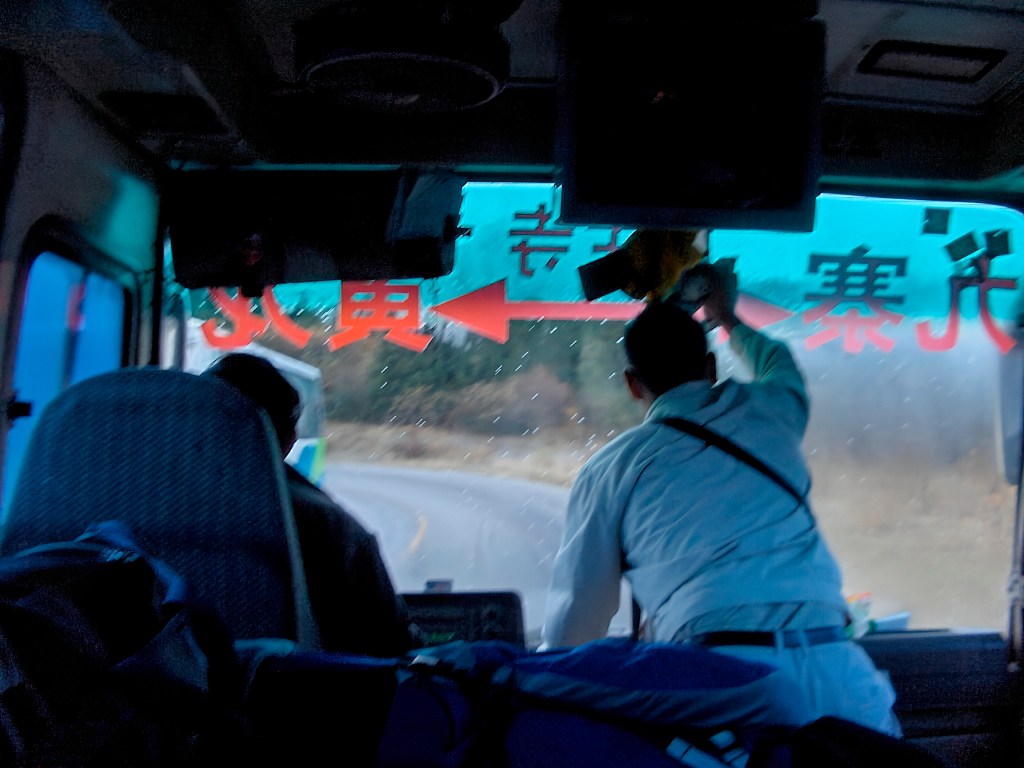
Here is one of my China posts, from my backlog of drafts.
In China, busses are a primary means of transportation for most people. Busses range from city busses up to large coaches, similar to Greyhound.
You haven’t really travelled in China unless you have ridden a local country bus. The kind that stops in every village, or for people who flag it down at the roadside. People will get on with live chickens or ducks. The old ladies gossip while they are travelling home or to the market.
On this trip, I had many opportunities to travel the mountain roads in Sichuan. The mountain busses in Sichuan are very slow. For example, it takes 3.5 hours to travel from Jiuzhaigou to Huanglong – a distance of 128km. This is an average of 37 km/h (23 mph). The trip from Chengdu to Jiuzhaigou averages about the same speed.
On an uphill climb, the driver is loathe to lose any momentum. Because of this, he will swing wide on corners. Worse, he will start passing a slower vehicle blindly, in a corner. If he slows down to follow the slower vehicle, it may take five minutes to regain the momentum to pass, so he just goes for it! This leads to many interesting occasions when the driver has to hit the brakes and duck back behind the slow vehicle, when there is an oncoming vehicle.
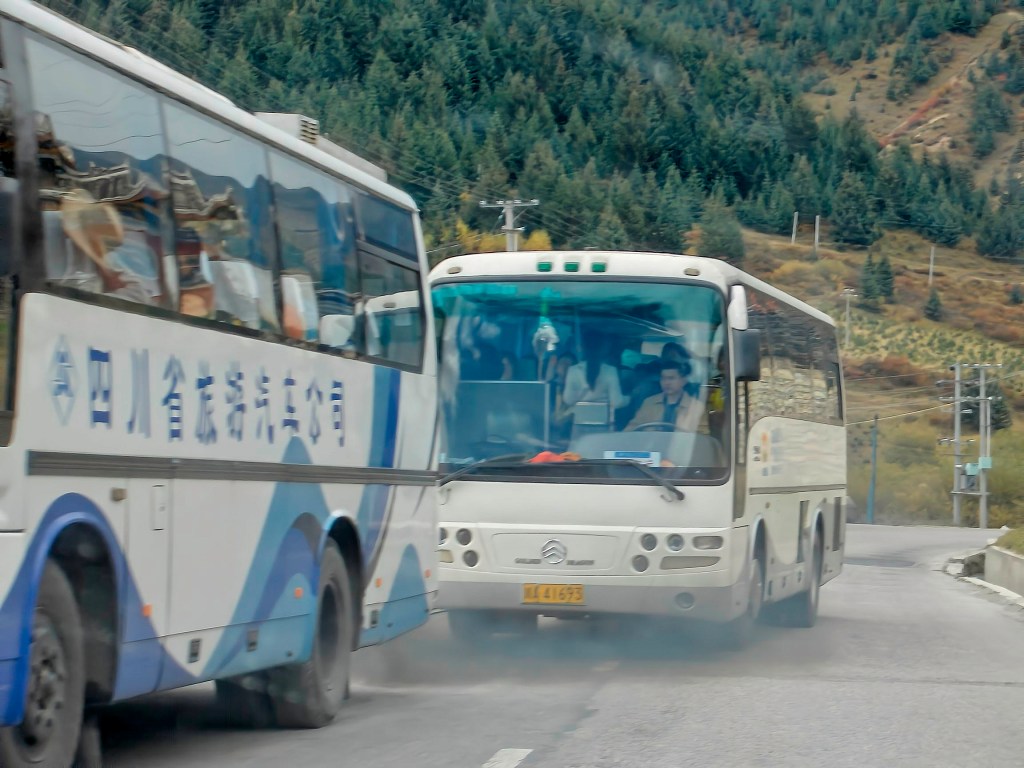
In the photo above, the rearward bus is ducking back into his lane. Notice the corner, a little further on! The rear bus came around the corner beside the front bus! This happens all of the time. (Also, note the woman standing at the front of the rearward bus. She is singing karaoke! Never, ever get on a karaoke bus!)
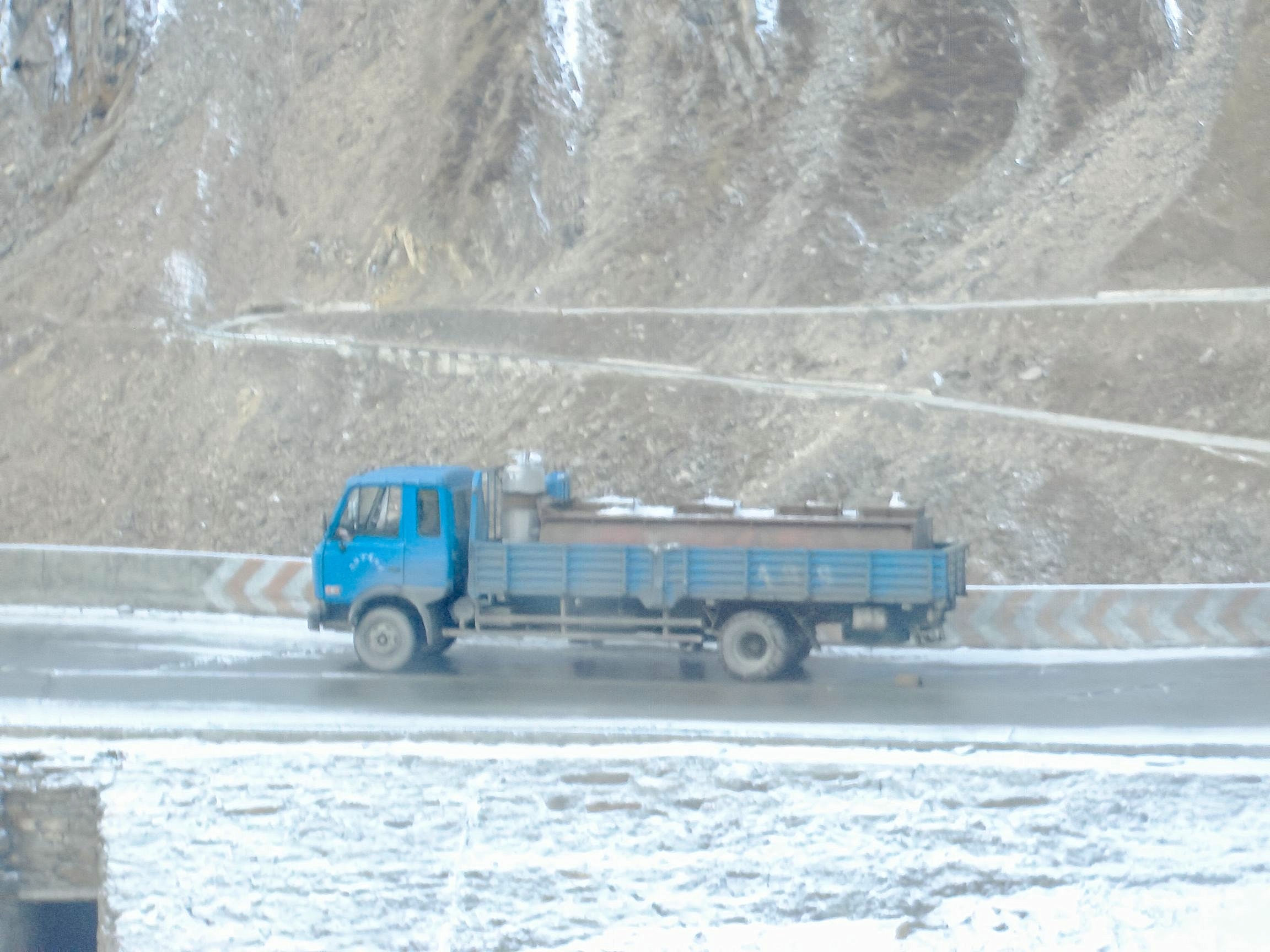
One of the main obstructions that slows down travel are the “blue trucks”. They are not always blue – sometimes they are red, orange, yellow, green, or white – but most seem to be blue. They always have the dull enamel paint.
Anyway, the blue trucks are used to haul just about anything, they are usually overloaded, and they are always very, very slow. And, they never, ever pull out to let any other vehicle past. They always just keep grinding along at their slow, slow pace!
I also was on two busses that were involved in minor accidents. The first time, some idiot decided to lower a gate across the road just as the bus approached. The driver slammed on the brakes, but hit the gate and travelled a full bus-length before it finally stopped. The gate was not a breakaway gate, nor was it hinged. However, it was made from flimsy material, and was bent. The bus had a cracked windshield. I cannot figure out why the gate was there, in the first place. There was not apparent reason to place the gate in that location!
The second accident involved the bus and a large blue truck trying to inch past each other on a one-lane section of road under construction. The bus pulled far over towards a roadside cliff, and the truck started pulling past. One barrel sticking out from the side of the truck’s load contacted the side-mirror on the bus, and cracked the housing. When this happened, everyone stopped dead, and got out to argue for twenty minutes. The people in the other vehicles waiting in line also got out to watch and attempt to mediate. Eventually, the truck driver pulled some money out of his pocket, peeled off Y400 (around $50), and gave it to bus driver (who probably just pocketed it).
Never travel on country roads at night! It is dangerous enough to travel in daylight. There is a special type of “sleeper bus” in China. These have two decks, because each seat is reclined very flat. The sleeper bus is dangerous because it travels at night, and the drivers get very fatigued. The two most serious bus accidents I’ve seen in China involved sleeper busses.
Fortunately, most of the non-sleeper busses are scheduled to run during daylight. Long distance busses, therefore, leave very early in the morning. Shortly after 6:00 is a common departure time!
Apparently, smoking is not permitted on busses. However, there are four levels of compliance:
- Full compliance. Passenger waits to exit bus before smoking
- It is okay to start a cigarette on the bus, and long as you exit before finishing. The corollary: It is okay to start off the bus, and finish on.
- If the bus is stopped and engine turned off, it is okay to smoke.
- No compliance. Smoke whenever you please.
 Michael Chmilar's Travels
You must be logged in to post a comment.